Using AI and Embedding AI Are Different Things
What the Government's new 300-page study on AI in Irish enterprise means for SME leaders, in eight pages.
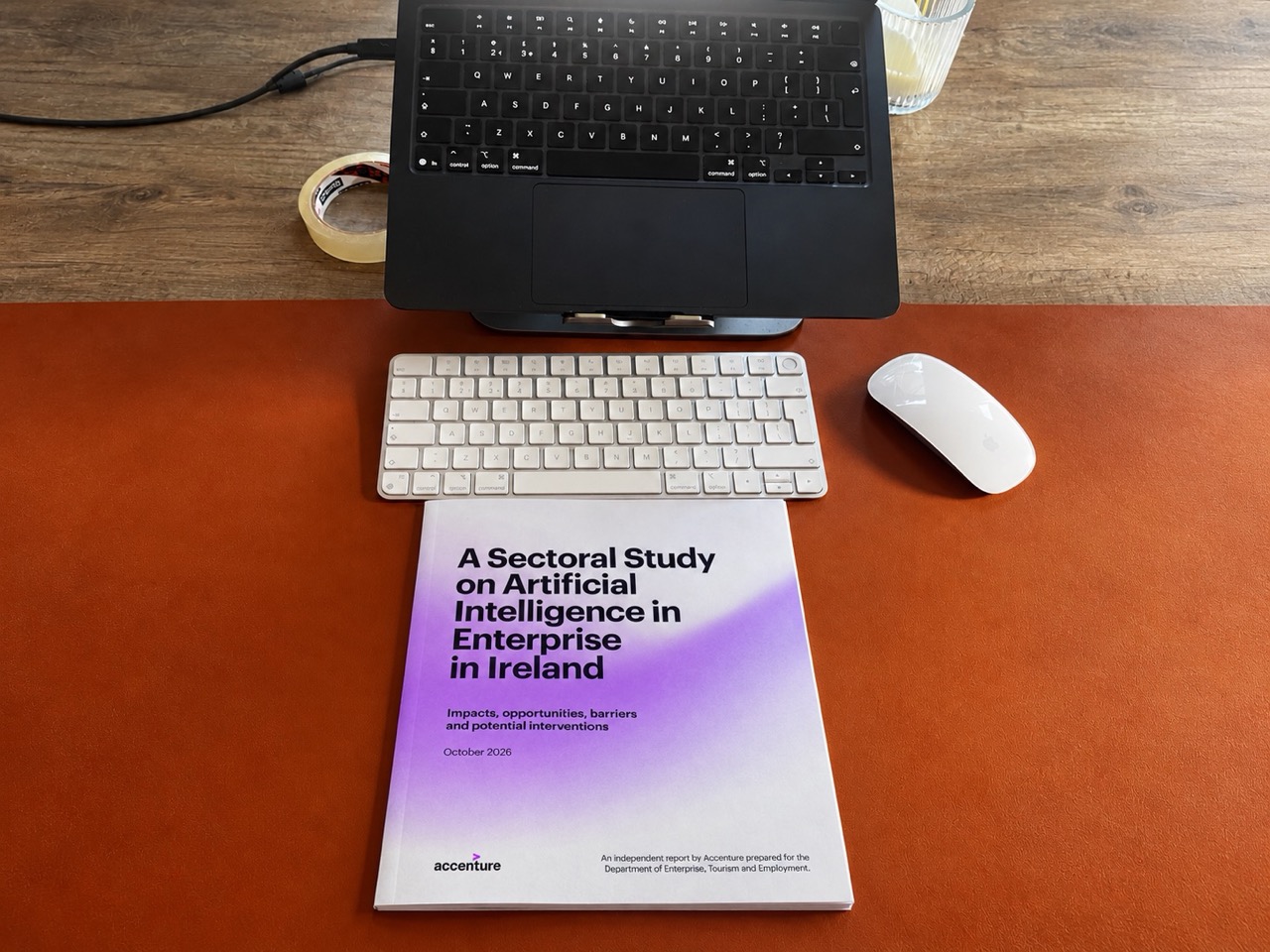
This month the Department of Enterprise, Tourism and Employment published a major study on how Irish firms are adopting AI. It was prepared independently by Accenture and runs to just under 300 pages. It is a serious piece of work: more than 500 global use cases, 30-plus interviews, 272 consultation responses and four sector workshops.
Most owner-managers will not read 300 pages. So we have read it for you, and distilled it into an eight-page summary you can download below.
AI in Irish Enterprise: the short version. The study's key figures, where the value sits, what gets in the way, the nine proposed interventions and six questions for your next leadership meeting. Eight pages.
The full study is the original Accenture report on enterprise.gov.ie. It runs to around 300 pages (PDF, 4 MB).
The headline
Irish firms are adopting AI faster than they are embedding it.
AI use among Irish enterprises with ten or more staff rose from 8% in 2023 to 20% in 2025. Daily use of generative AI at work almost tripled over a similar period, from 8% of workers in 2024 to 22% in 2026. Yet when the study's consultation asked firms how deep their use went, half described task-level use. Only 15% had a pilot or embedded workflow, and 10% a scaled operating model.
It reminds me of a band where everyone has bought a new instrument and nobody has agreed the key. Lots of individual sound. Not much music yet.
Where the value actually sits
The study is clear that the near-term opportunity is in operations. Forecasting demand, planning production, spotting defects earlier, maintaining equipment, controlling project cost. These are decisions Irish firms already make every week. AI improves them when it can reach the right data at the moment the decision is made.
The study also notes that most of these gains do not need frontier technology. Established predictive tools, or AI already inside software you pay for, often do the job at lower cost and lower risk.
What gets in the way
The technology is rarely the main constraint. The barriers that come up again and again are familiar to anyone who has run a systems project: no clear owner, no protected time for the people who know the process, data scattered across systems, and a tendency to bolt AI onto old ways of working.
The study also names something we see often with medium-sized firms. It calls them the "squeezed middle". A pilot is affordable. Putting it into daily use, with integration, process change, governance and running costs, can be a much larger bill that nobody planned for.
What the study recommends
It proposes nine potential interventions, from a national awareness campaign to stage-gated funding that covers the full cost of implementation. These are recommendations for government and agencies to consider, not announced schemes. Several existing routes are already referenced in the report, including Enterprise Ireland's Make AI Work pathway, the Digital Discovery Voucher and LEO Digital for Business. Eligibility varies, so check with the relevant agency.
Our view
You do not need to wait for new schemes. The firms that get the most from existing supports arrive with three things: a defined problem, a named owner and an honest view of where their data lives.
The summary closes with six questions for your next leadership meeting. The first is the one we would start with: which three recurring decisions most affect our margin, and could better forecasting or detection improve them?
Download the eight-page summary (PDF)
Source: Accenture (2026), A Sectoral Study on Artificial Intelligence in Enterprise in Ireland: Impacts, opportunities, barriers and potential interventions. Independent report prepared for the Department of Enterprise, Tourism and Employment. Read the full report at enterprise.gov.ie. This summary is an independent interpretation by RevenueOS and is not endorsed by DETE or Accenture.