The Medicine Cabinet Problem
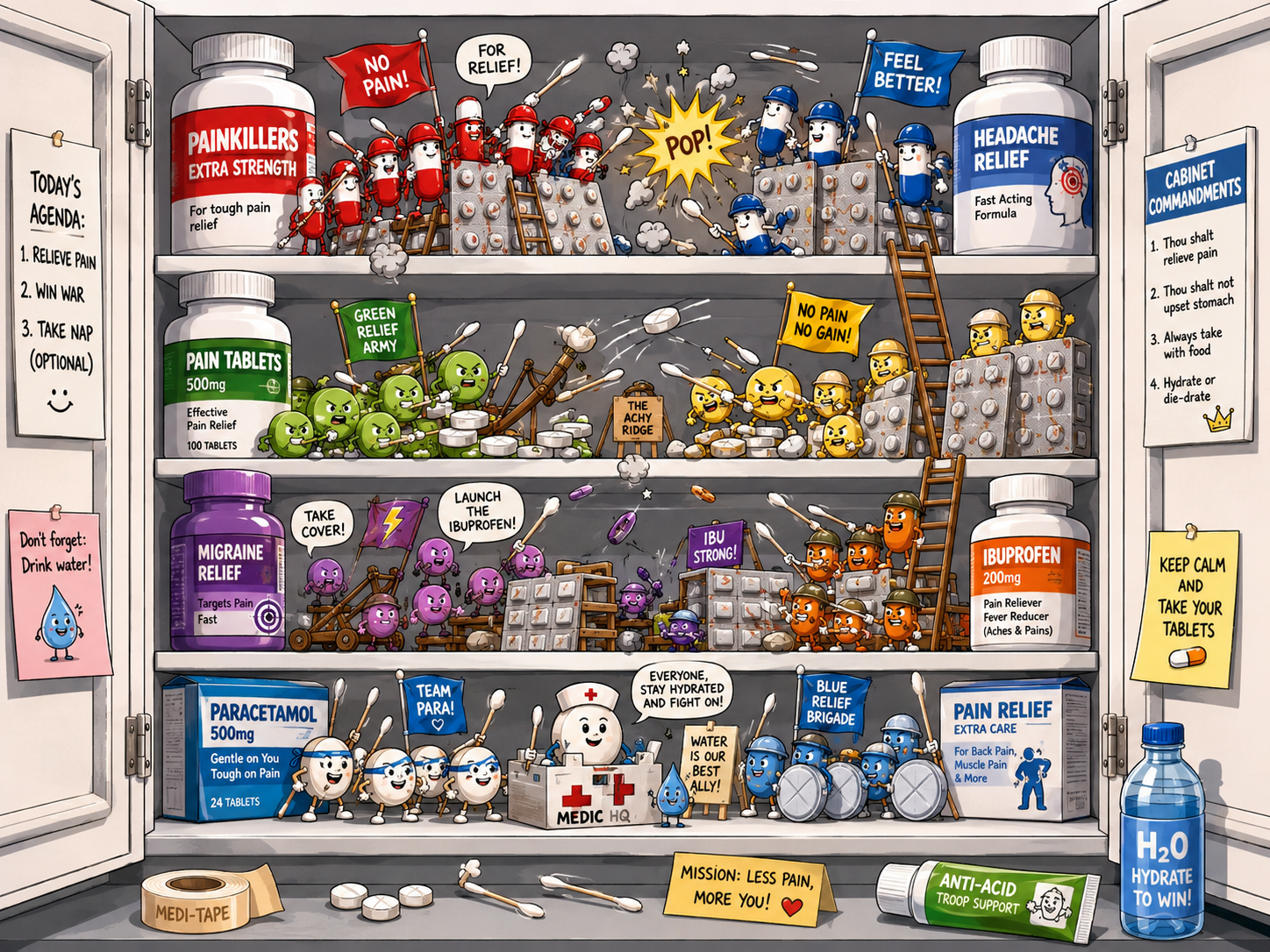
We train salespeople to only ever sell painkillers.
It is one of the first things we coach. Never sell candy, because candy is a throwaway and the first thing cut when money gets tight. Never sell vitamins, because vitamins are nice-to-have, and nice-to-have dies quietly in the budget meeting. Sell the painkiller. The acute, urgent, need-it-now fix that justifies its own cost. Good salespeople learn to find the pain, name it, and present themselves as the relief. That is not manipulation. That is the craft working as it should.
I still believe it is the right way to train a sales team. What follows is what happens when you stand on the other side of that table and watch the same discipline play out a hundred times over.
The diagnosis you didn't know you outsourced
Picture how software actually gets bought in a mid-sized business.
A pain shows up. Reporting is slow, or two teams keep tripping over each other, or something that used to take an afternoon now takes a week. The owner, sensibly, asks someone to go and look at options. Usually that someone is the IT manager or a small internal team, and off they go to talk to vendors.
Here is the quiet problem. Every vendor they meet has been trained, by people like me, to do exactly one thing well: take whatever pain gets described and reframe it as acute, urgent, and precisely the shape of the product they happen to sell. They are not lying. They genuinely believe their bottle is the answer, because their whole working life has been spent making that bottle the answer. Give a CRM specialist a vague ache and they will, in good faith, diagnose a CRM-shaped problem. Give the same ache to an ERP partner and you will get an ERP-shaped problem.
The person describing the cure is the person who profits from it. We would never accept that arrangement from a doctor. In software, we do it constantly and call it talking to a partner.
And before you reach for the obvious fix, the fix does not work either. The instinct is to find someone neutral. A vendor-agnostic integrator. An independent technology advisor. But neutral does not exist in this market. The integrator is certified in two platforms and earns margin on both. The advisor has three logos they are genuinely good at and a natural pull toward all three. Everyone has a bottom to their bag. Whatever is in the bag becomes the diagnosis, every time, no matter how honourable the person carrying it.
How a business becomes a medicine cabinet
Now run that forward.
Each individual decision is defensible. The CRM made sense the year you bought it. So did the ERP. So did the marketing platform, the support desk, the analytics layer, the workflow tool somebody championed after a good demo. Every one of them solved a real pain, presented by a credible person, at a moment when it genuinely hurt.
Stack ten of those decisions across five or six years and something has quietly gone wrong. You no longer have a business with tools. You have a medicine cabinet. A shelf of painkillers, each sensible in isolation, now interacting badly with one another. Two systems that cannot agree on what a customer is. Someone on the team losing two days every month assembling a report by hand, copying figures from one system into another, because the tools that should talk to each other simply do not. Three teams each convinced they own the same metric, working from three different versions of it.
Nobody decided this. It accumulated, one acute pain at a time, each treated on its own terms by someone who only stocked one cure.
There seems to be a threshold, somewhere around the thirty to fifty million turnover mark, where this stops being an irritation and starts being a drag on the whole enterprise. Below it, willpower and good people paper over the gaps. Above it, the painkillers are interacting badly enough that the cost shows up in the things owners actually feel: slower decisions, softer numbers, a leadership team spending its energy reconciling systems instead of running the company. It is also, not coincidentally, the band where founder-dependency and messy operations start to compress the multiple when anyone looks closely at the business.
The question that takes the pen back
The uncomfortable realisation, when it lands, is this. There was never a diagnosis. There was a sequence of prescriptions, each written by someone holding the cure, and the business was assembled from whatever those encounters produced.
So the work is not to find a better prescriber. You have just seen that every prescriber has a bag with a bottom. The work is to take the pen back, and that begins with a question you have to ask yourself before you ask it of anyone selling.
Not what should we buy.
But how is this business actually meant to run.
What is it for, what has to happen for it to do that well, and how should the parts connect to support it. This is what I mean by a business operating system, and I am wary of the phrase because it can sound like consultant fog. So let me make it plain. It is a description of how your company is supposed to work as a whole, written down, owned by you, before a single vendor call. It treats the business as one connected system rather than a list of discrete problems waiting for discrete bottles.
Once you have that, everything inverts. The vendor conversation stops being a diagnosis and becomes a test. Does this thing serve the way the business is meant to run, or does it just quieten one symptom while creating two more downstream? You can finally tell the difference between a painkiller you need and one that simply found you at a weak moment.
You stop buying cures. You start designing for health.
That is the shift. And the only person who can begin it is the one person in the room who is not holding a bottle.
This is most of what we do now. As we map a company's operating system, the same pattern surfaces again and again: a painkiller war running underneath the business, with IT leadership worn down trying to broker peace between tools that were never meant to live together. So the work starts before any prescription is written. Map how work actually flows through your company. Build a clear, honest picture of what you genuinely need, set down in the language of your own operation rather than any vendor's catalogue. Only then do we reach for the pad, together, and write a plan that fits your business rather than someone's sales target.
We don't sell the painkillers. We help you diagnose properly, and then write the prescription that's right for your business.
If your tools have started fighting each other, that is worth a conversation.